
Company overview
The whole picture on one page.
Edka in one sentence
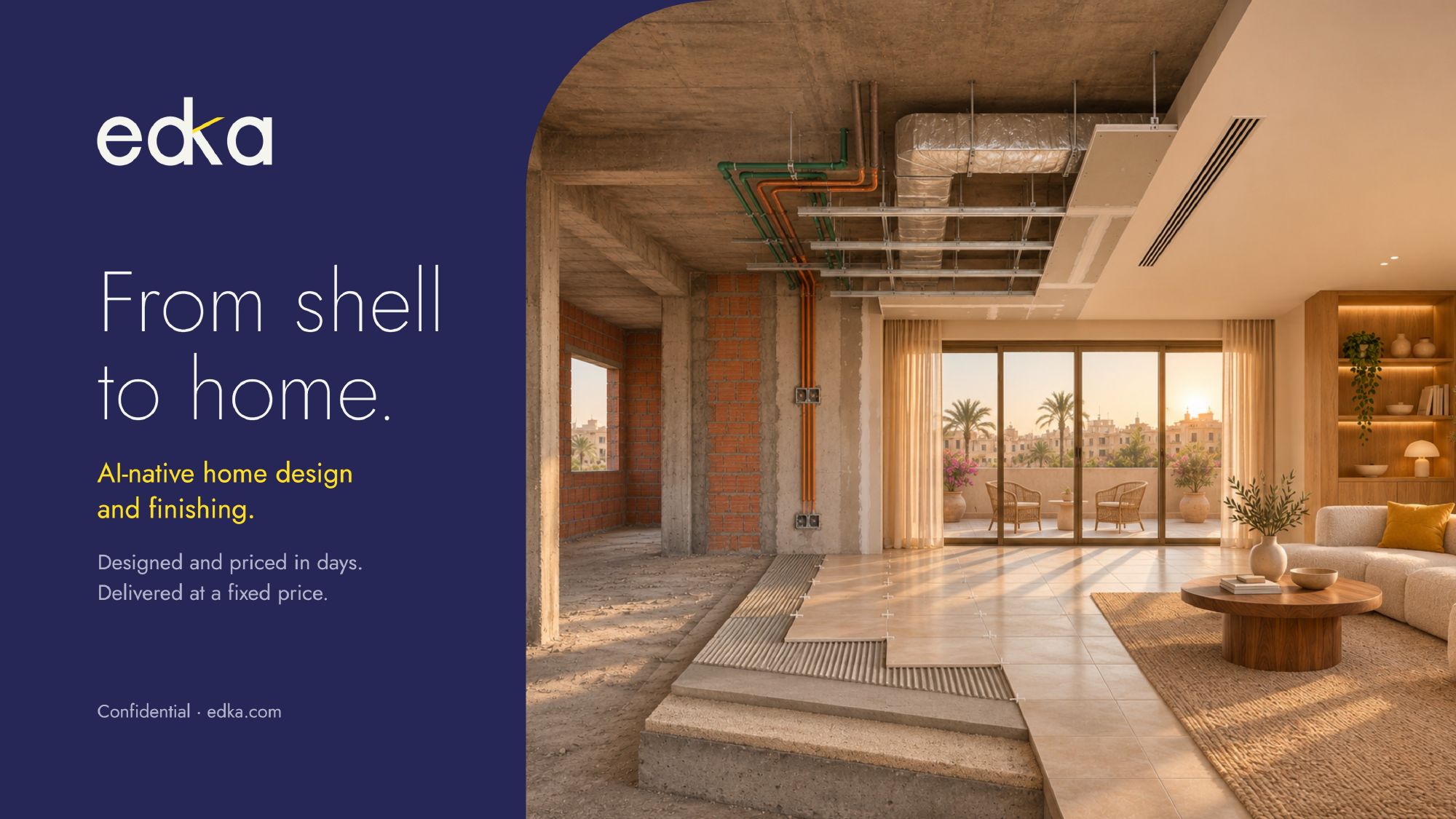
Edka turns Egypt's bare concrete ("core-and-shell") homes into finished, furnished homes: designed and priced in days, then delivered by Edka at one fixed price.
The problem
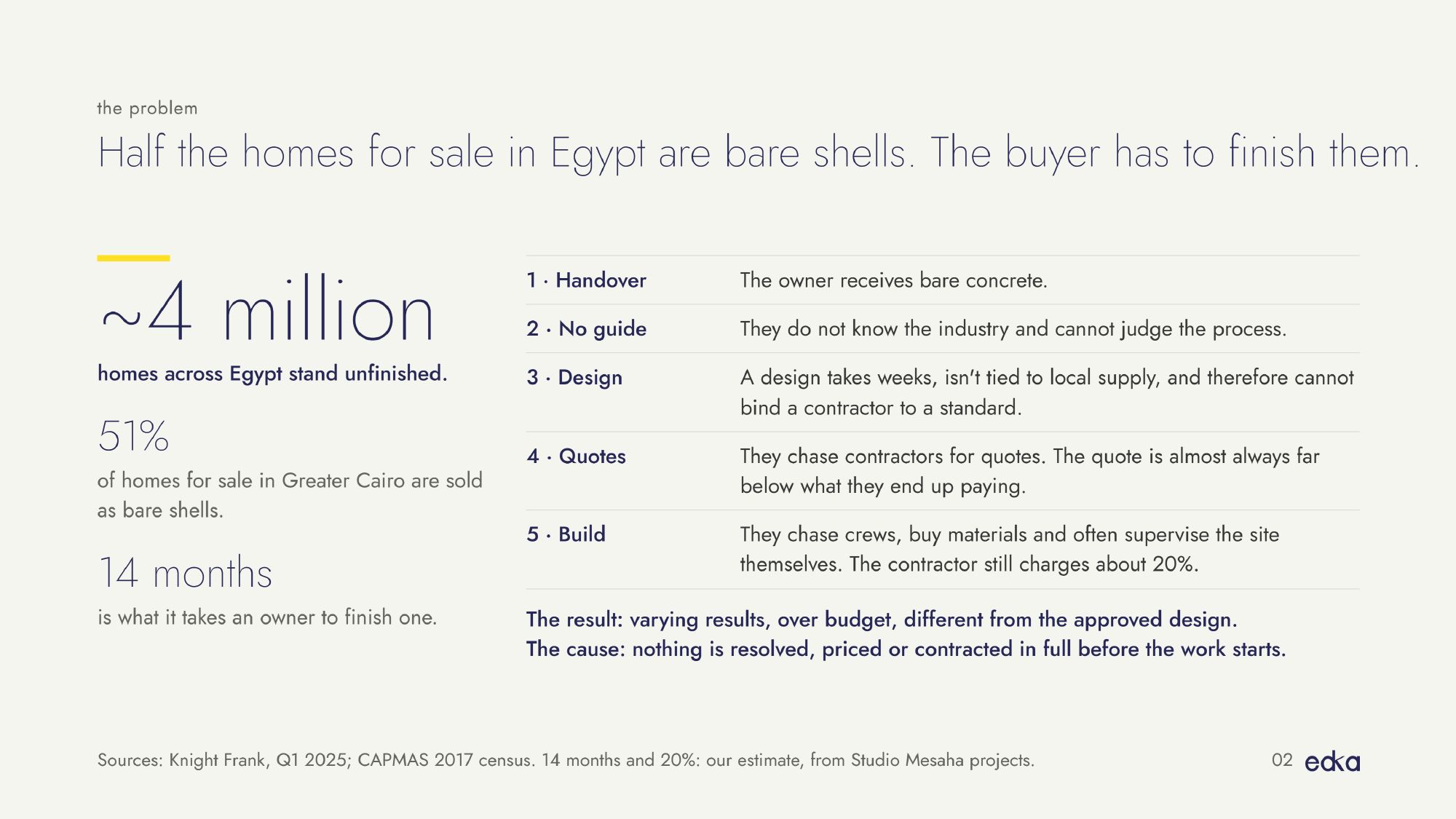
About half of the new homes for sale in Greater Cairo are handed over as bare concrete shells (51%, sourced: Knight Frank, Q1 2025). The owner must then design, finish and furnish the home. Today no route gives the owner all five things they want at once: a fair price that holds, a date that holds, quality as designed, a design of their own, and a complete home. Owners spend about 14 months (estimate, from Studio Mesaha projects) managing designers, contractors, trades and suppliers.
What Edka does
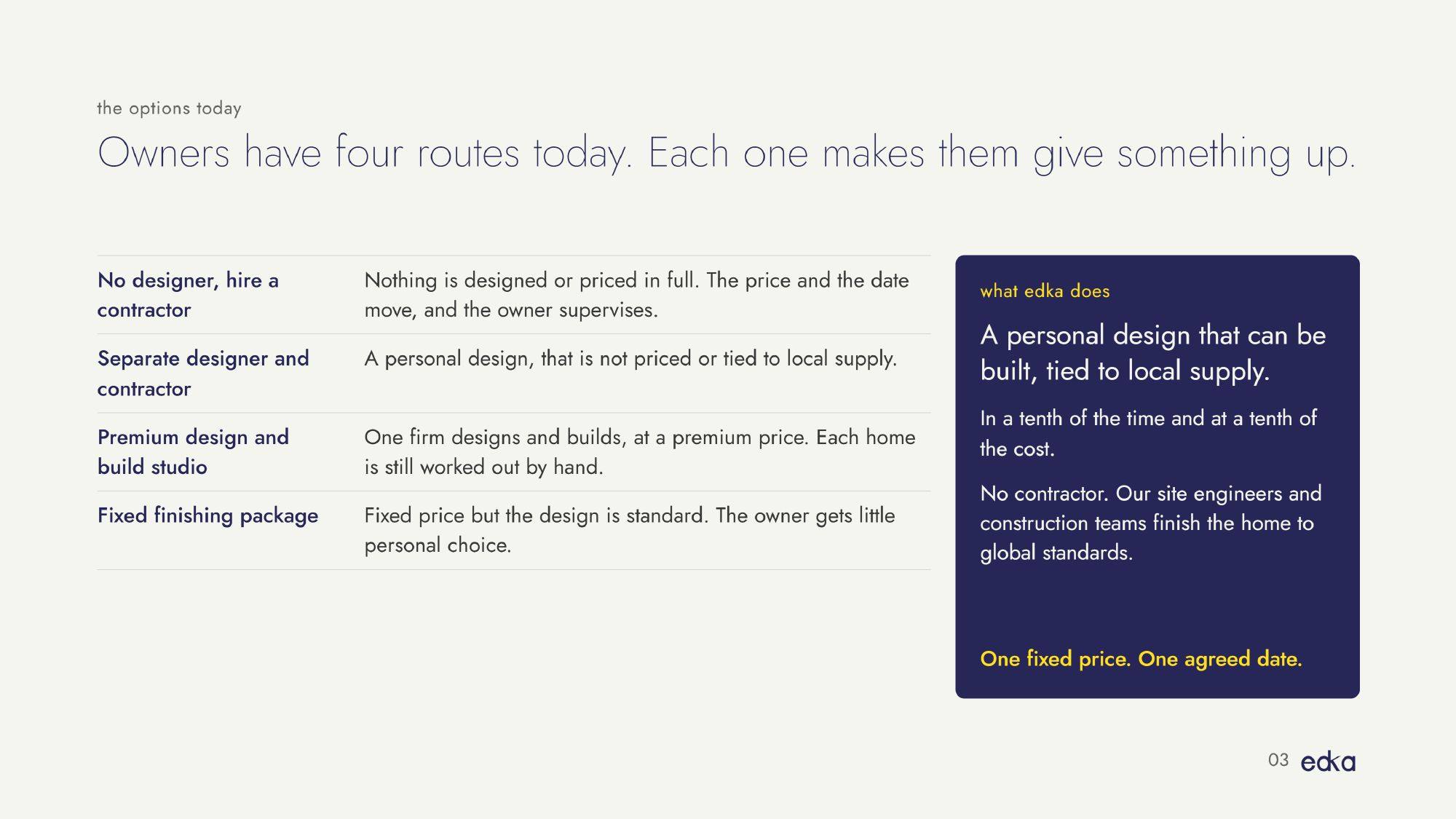
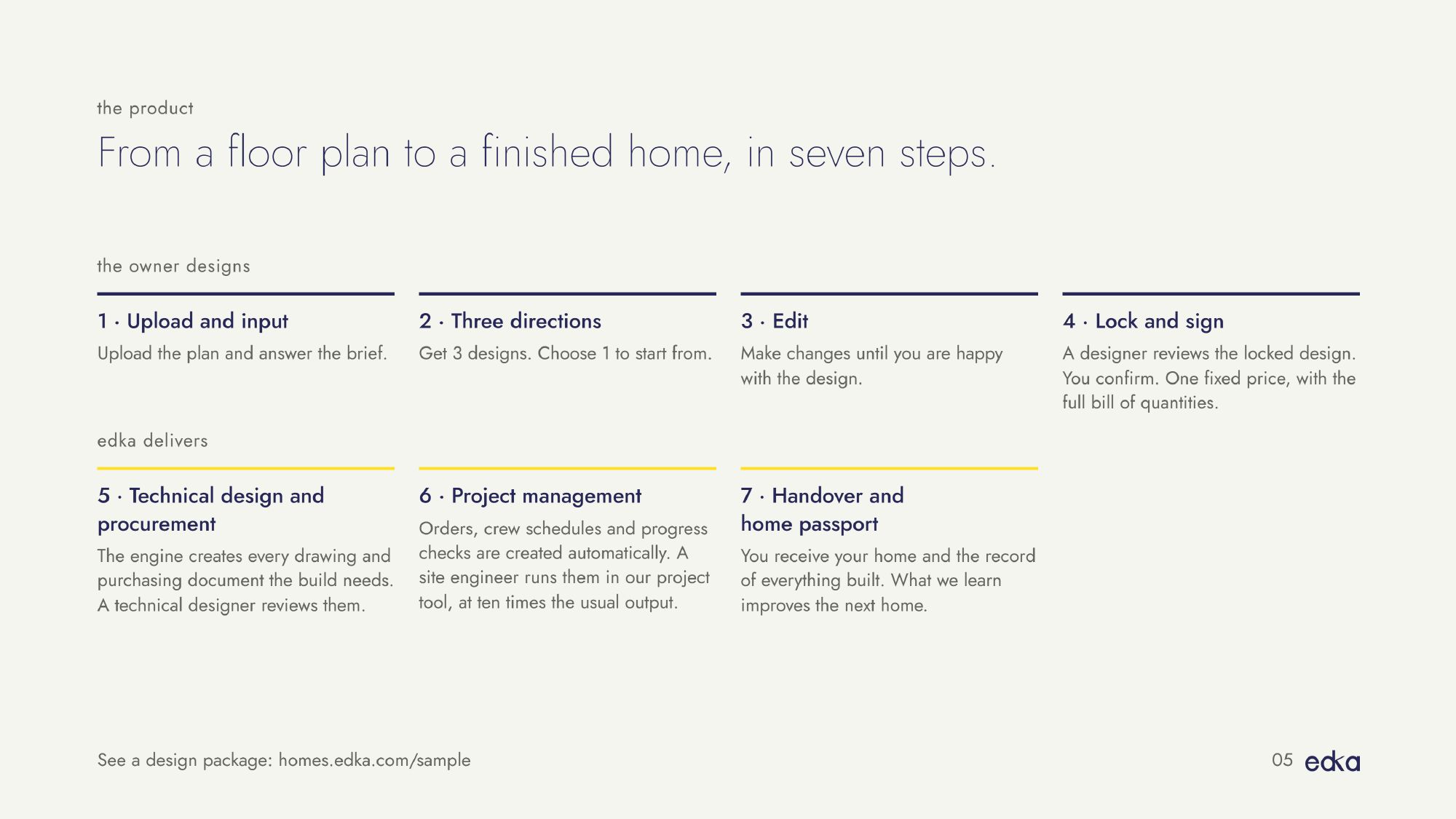
The owner gives Edka the home's plan and a short brief: how they live, the style they like and their budget. Edka returns a personal design in 3D, made only from products that can be bought in Egypt, with one fixed price for the whole finished and furnished home. The owner can change the design and sees the price update. A designer reviews every design before the owner sees it. Edka then runs the site itself, working directly with trades (such as tilers, plumbers and electricians) and workshops (such as joinery), with no main contractor in between. The price changes only if the owner changes the design.
Why Edka can do this
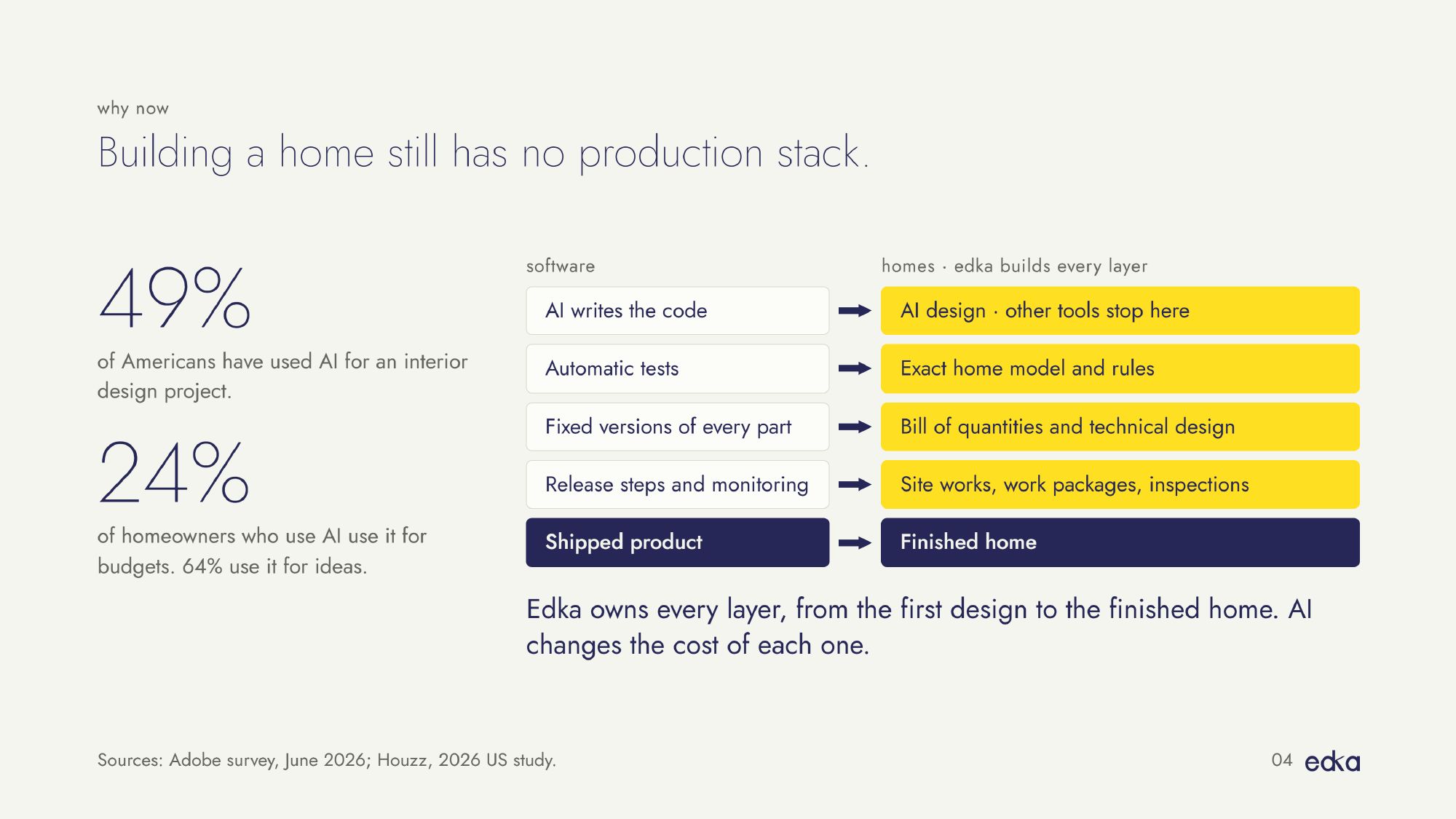
Software and AI do most of the design and planning work that takes experts weeks today. The numbers promised to an owner, such as the price and the quantities, are worked out by our own software from the home's exact measurements, not estimated by hand. Every home Edka finishes adds real costs and durations to our records, so the next price and the next build get more accurate.
Market
Our first market, high-value compounds in Greater Cairo and on the North Coast, is worth $1.2 to 1.8 billion a year (calculation; see Market).
Who it is for
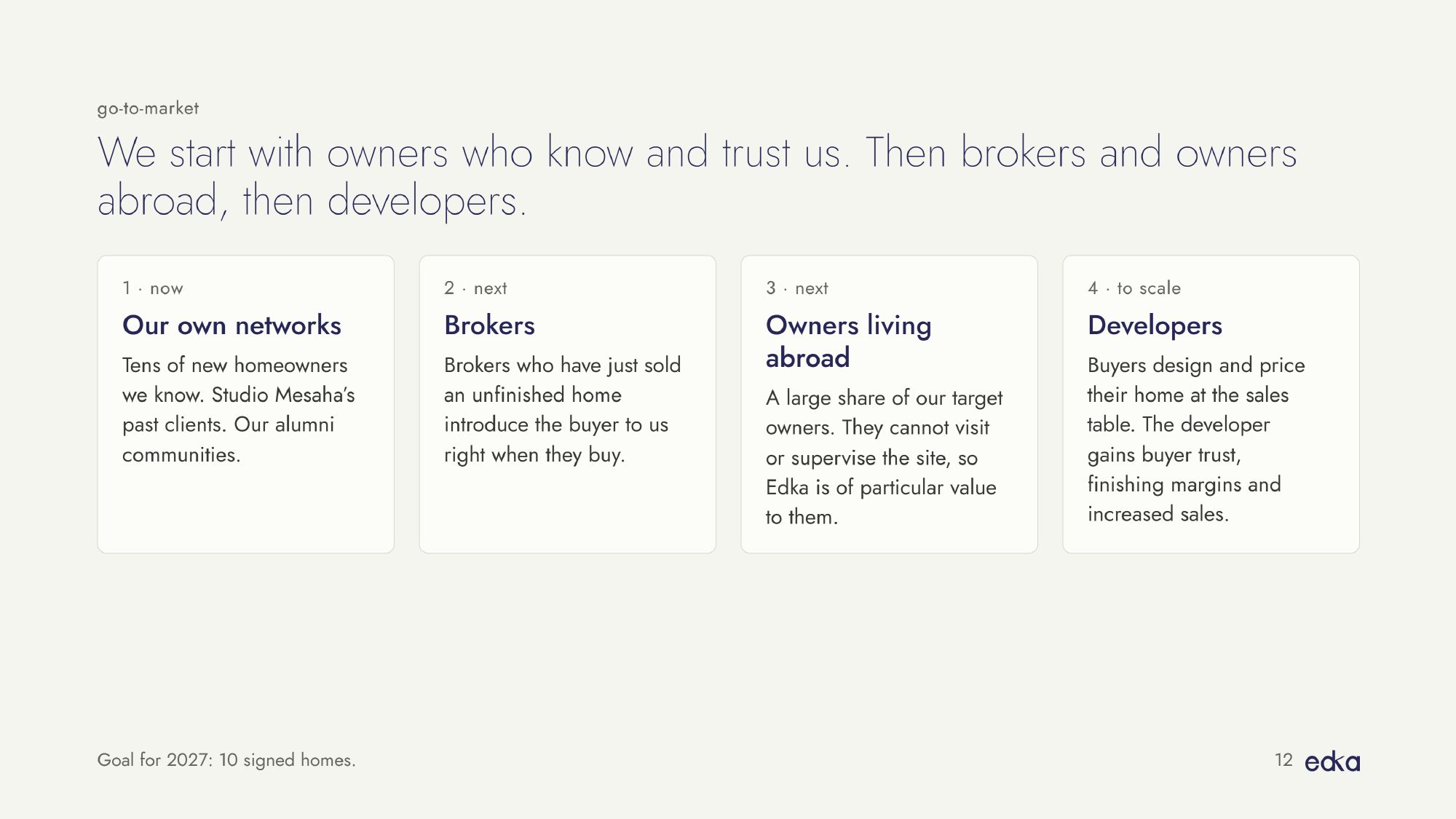
First: owners who already pay a premium for a good result and do not want to supervise the work themselves, in New Cairo, 6th of October, the North Coast and the Red Sea. Egyptians living abroad who own homes in Egypt are part of this group. Second: real estate developers, who lose sales when units stay unfinished. Developers come later.
Where we are
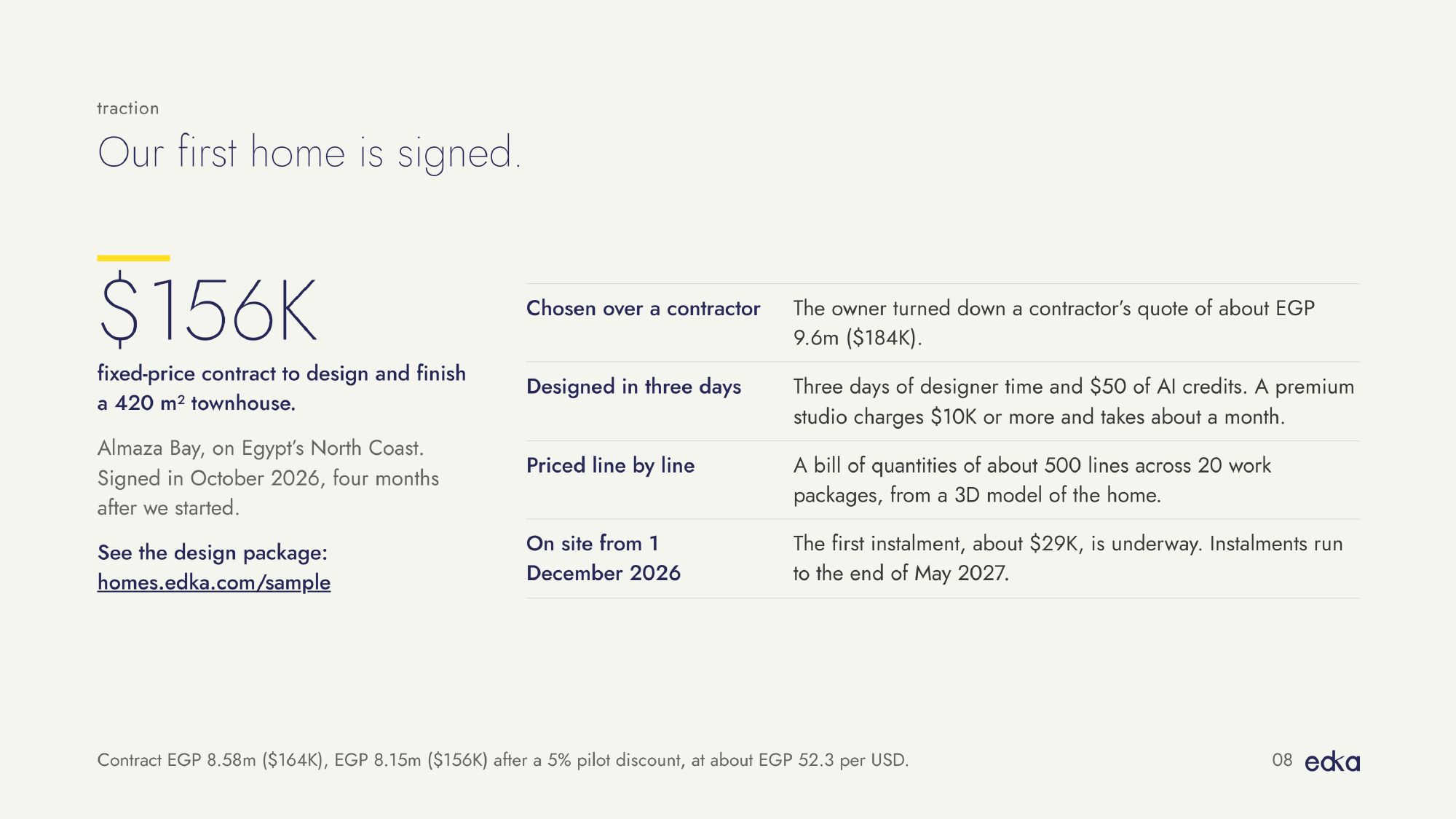
- Our first client, the owner of a 420 m² townhouse on Egypt's North Coast, signed a contract in October 2026 for one fixed price to design and finish the whole home. Work on site is planned to start on 1 December 2026.
- The first working version of the product, from the plan and the brief to a priced 3D design, is being built now. It will be reviewed on 10 December 2026.
Company
Edka Labs, Inc., a Delaware C corporation in the United States, with Edka Labs LLC in Egypt. Headquarters and first market: Egypt.
Founders
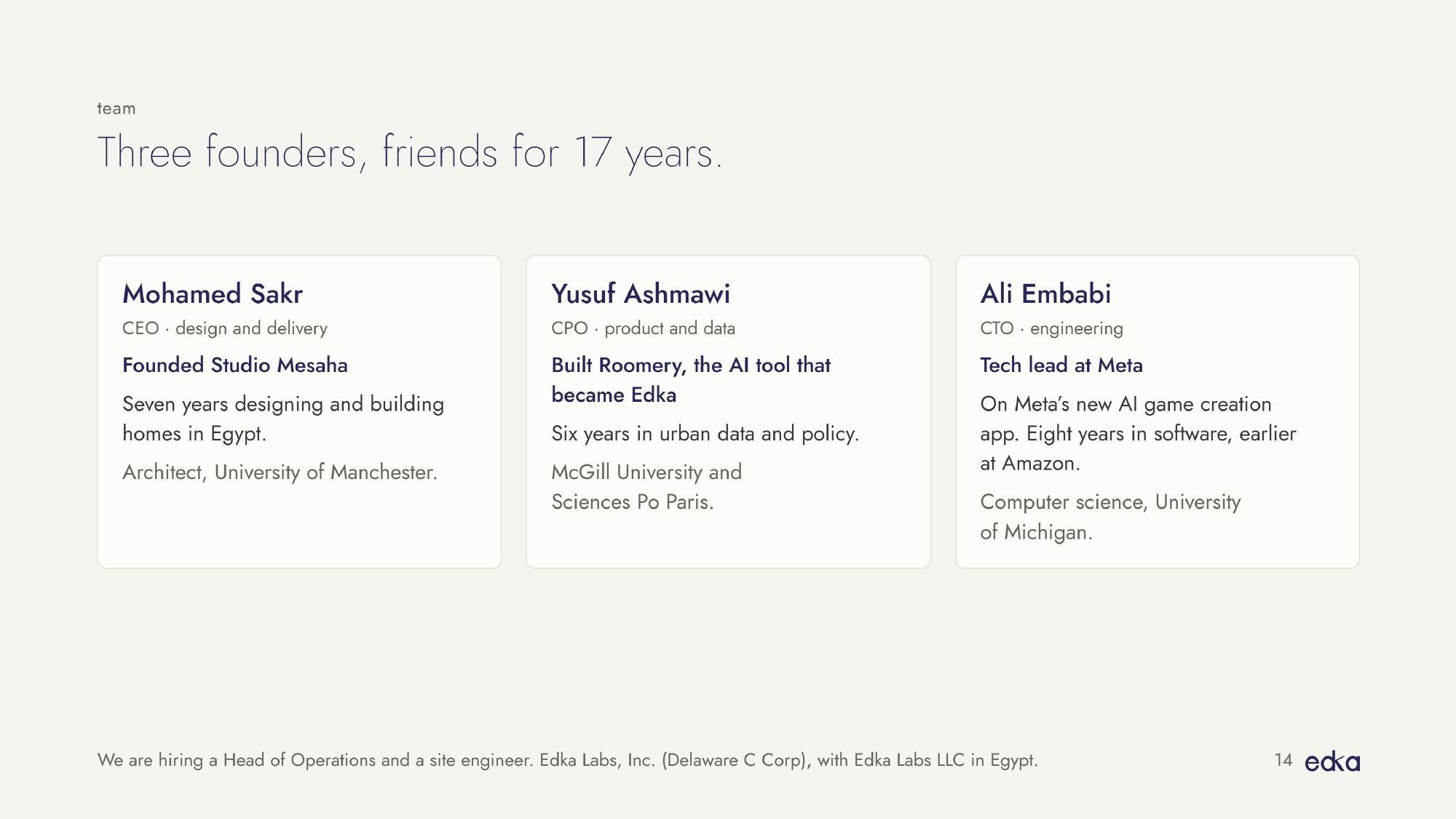
Mohamed Sakr (CEO, design and delivery), Yusuf Ashmawi (CPO, product and data) and Ali Embabi (CTO, engineering). More in Team.
Pitch deck
Our investor deck, November 2026.
Use the arrows or the arrow keys to move through the slides. Press Esc to leave full screen.
Market
Each number says whether it is sourced, an estimate or a calculation.
The first market: four areas with repeat unit types
We start in New Cairo, 6th of October, the North Coast and the Red Sea. Buyers want to live in these areas, and compounds there repeat the same unit types.
- About 51% of homes for sale in Greater Cairo are bare shells (sourced: Knight Frank, Cairo Residential Market Review, Q1 2025).
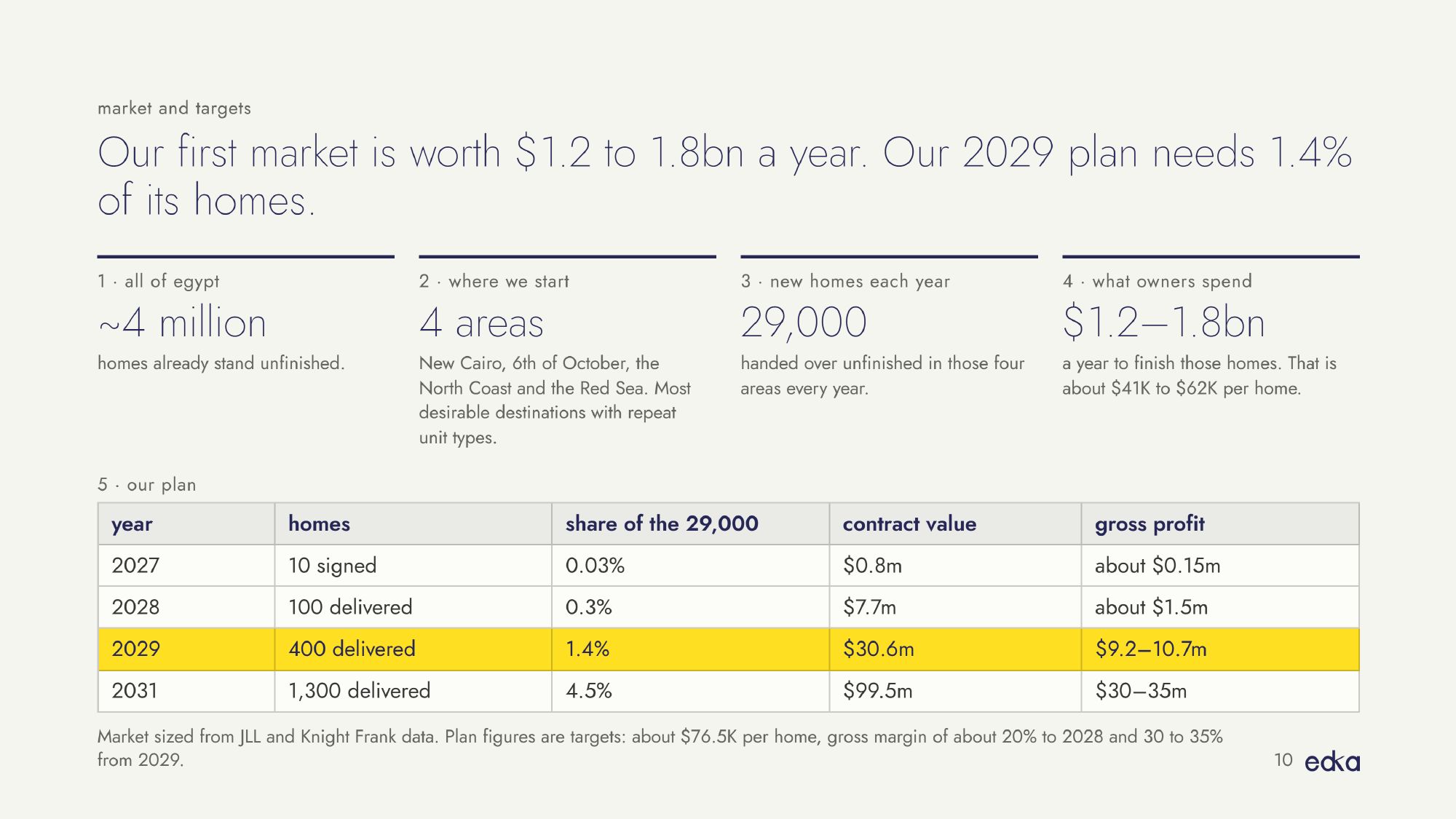
- About 29,000 homes are handed over unfinished in these four areas each year (calculation, from JLL and Knight Frank data).
- Owners spend about $41,000 to $62,000 to finish each one (estimate).
- This gives a first market of $1.2 to 1.8 billion a year (calculation).
The wider market in Egypt
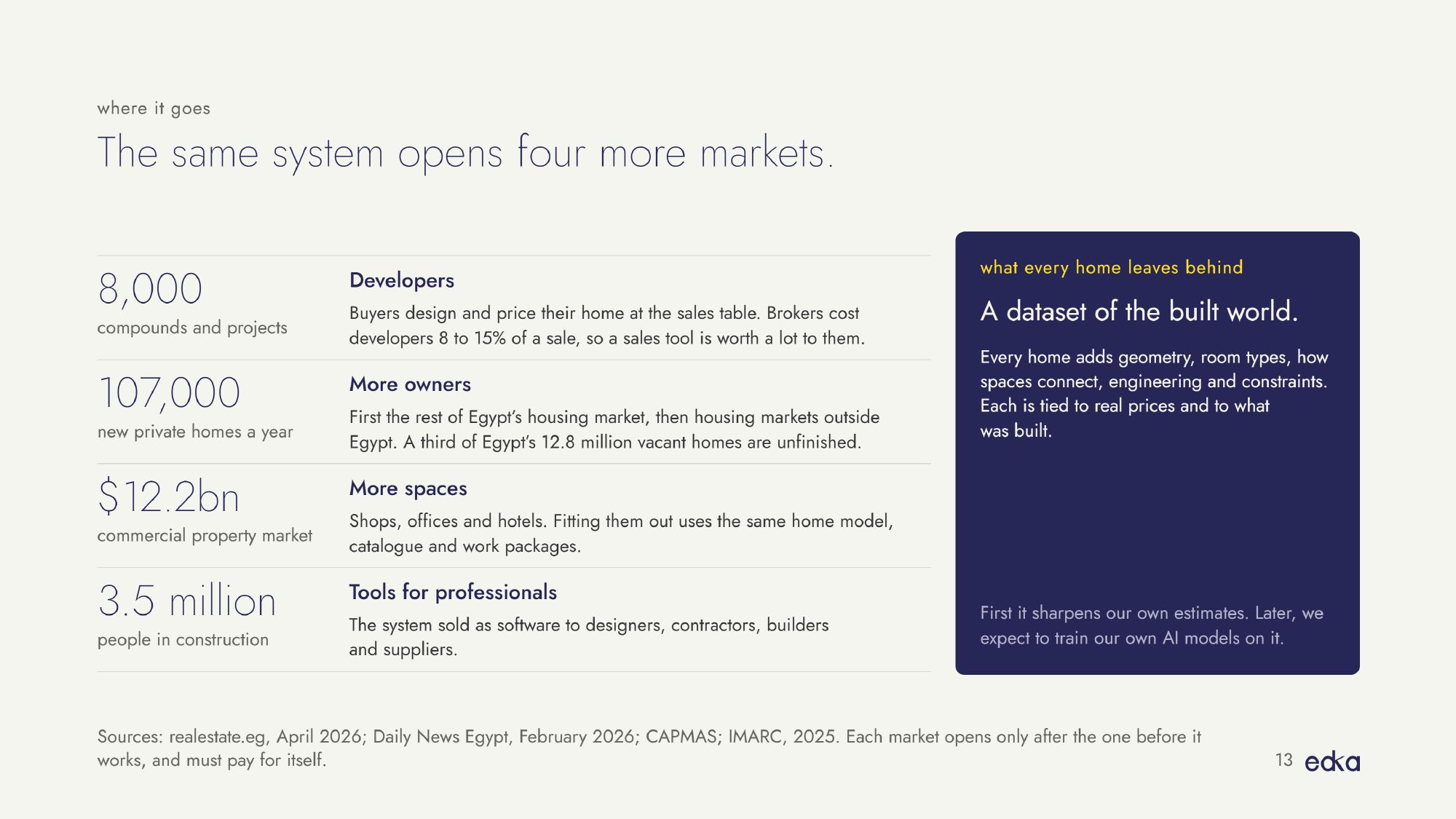
- The private sector built about 107,000 new homes in Egypt in 2024/25 (sourced: CAPMAS, Annual Housing Bulletin 2024/25). The same product serves them at lower prices.
- About 4.3 million homes in Egypt stood empty and still needed finishing (sourced: CAPMAS, 2017 census). This is a stock of homes, not a yearly flow.
Why demand is growing
- More buyers now buy a home to live in. Buyers buying mainly to invest fell from 55% in 2024 to under 20% in 2025 (sourced: The Board Consulting, via Enterprise, 2026). A buyer who lives in the home needs it finished.
- Egyptians abroad sent a record $47.3 billion home in fiscal year 2025/26 (sourced: Central Bank of Egypt, August 2026). Many own homes in Egypt that they cannot supervise. We have not found data on how much of this goes into housing.
- Many people already use AI to imagine their homes, but few use it to plan or price the work: 49% of Americans have used AI for an interior design project (sourced: Adobe survey, June 2026), and of homeowners who use AI, 64% use it for ideas but only 24% for budgets (sourced: Houzz, 2026 US study).
Beyond the first market
The same system can later serve the rest of Egypt's new homes, homes outside Egypt, shops, offices and hotels, and professionals who would use it as software. Each market opens only after the one before it works.
Product and progress
What the owner gets, our first client, and next steps.
What the owner gets
- A brief. The owner gives the home's plan and answers a short set of questions: how they live, the style they like and their budget.
- A design. Edka returns a personal design of the whole home in 3D, made only from real products that can be bought in Egypt.
- Changes, priced at once. The owner changes the design themselves and sees the price update with each change.
- One fixed price. When the owner is happy, the design is locked, and the owner signs one fixed price for the finished and furnished home, with every line visible.
- Delivery. Edka runs the site, works directly with trades and workshops, and the owner follows progress. The owner pays on a payment plan of instalments.
A designer reviews every design before the owner sees it.
What makes the price hold
The price, the quantities and the work on site all come from the same exact record of the home. Our software works out these numbers; an AI model never sets a number promised to an owner. Any price shown to an owner can be worked out again exactly.
Progress so far
- First client. The owner of a 420 m² townhouse on Egypt's North Coast signed a contract with Edka in October 2026, for one fixed price to design and finish the whole home, four months after we started. Work on site is planned to start on 1 December 2026. The site team will record the real quantities, costs and durations of each part of the work, so we can check our prices against what really happened.
- Product. The first working version of the whole product is being built now, end to end: from a home's plan and the owner's brief to a 3D design with real products, then the price, the bill of quantities (the priced list of everything needed) and the work packages (the units of site work). It runs on two test homes and will be reviewed on 10 December 2026.
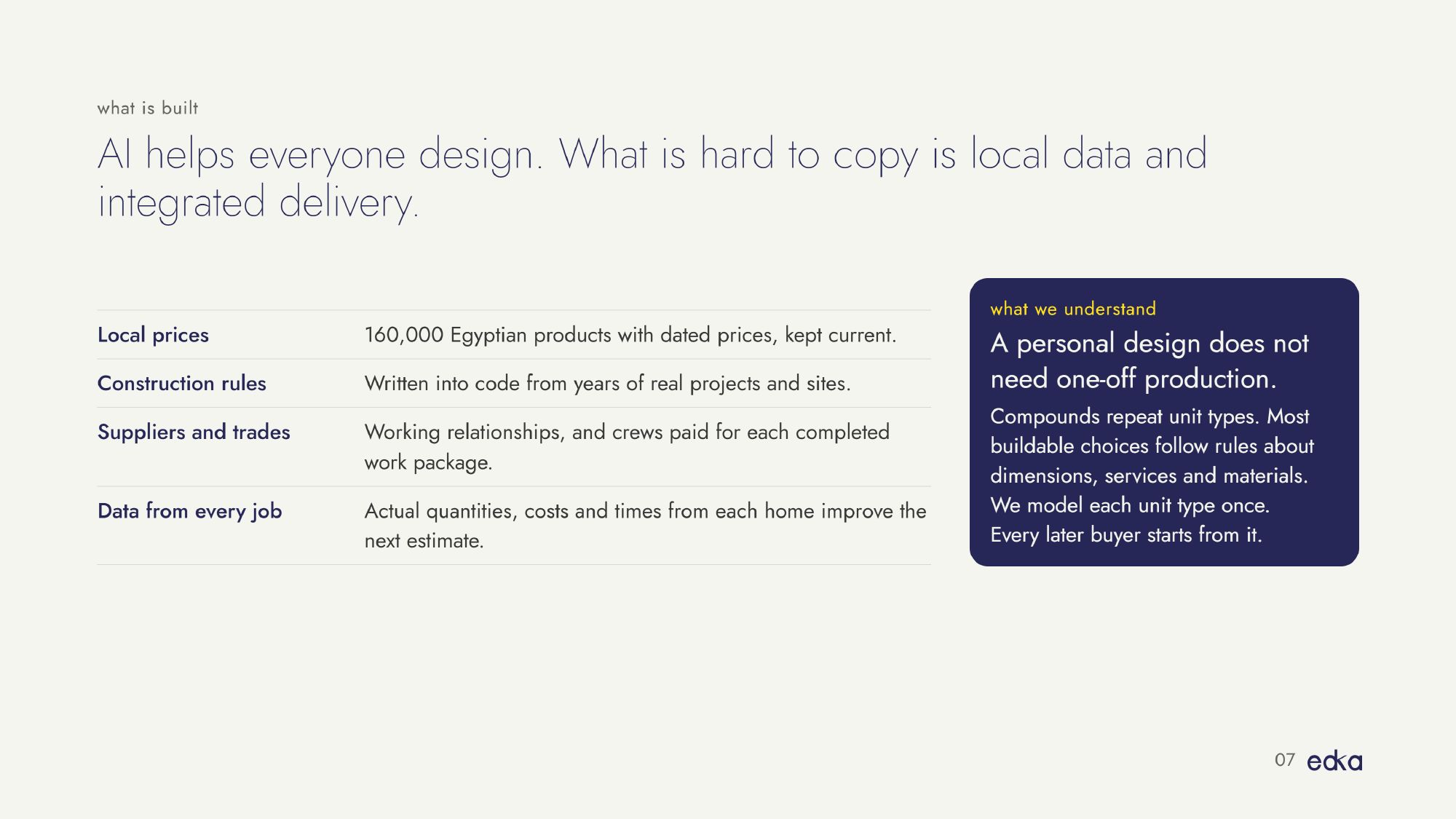
- Product catalogue. About 160,000 Egyptian products with dated prices (sourced: our catalogue, November 2026).
- Team. Three co-founders: Mohamed Sakr (CEO, design and delivery), Yusuf Ashmawi (CPO, product and data) and Ali Embabi (CTO, engineering). The Technology section lists what the product is built with.
Next steps (targets)
- Start work on site at the first client home (December 2026).
- Review the first working version of the product (10 December 2026).
- Sign the next owner homes and run each through the product.
- Deliver the first homes at a real cost within 10% of the cost we estimated before signing. This shows that a fixed price is safe for Edka.
A product walk-through
A sample design package is at homes.edka.com/sample. We also show the product in a call.
Business model and plan
All plan figures are targets, not results.
How Edka earns
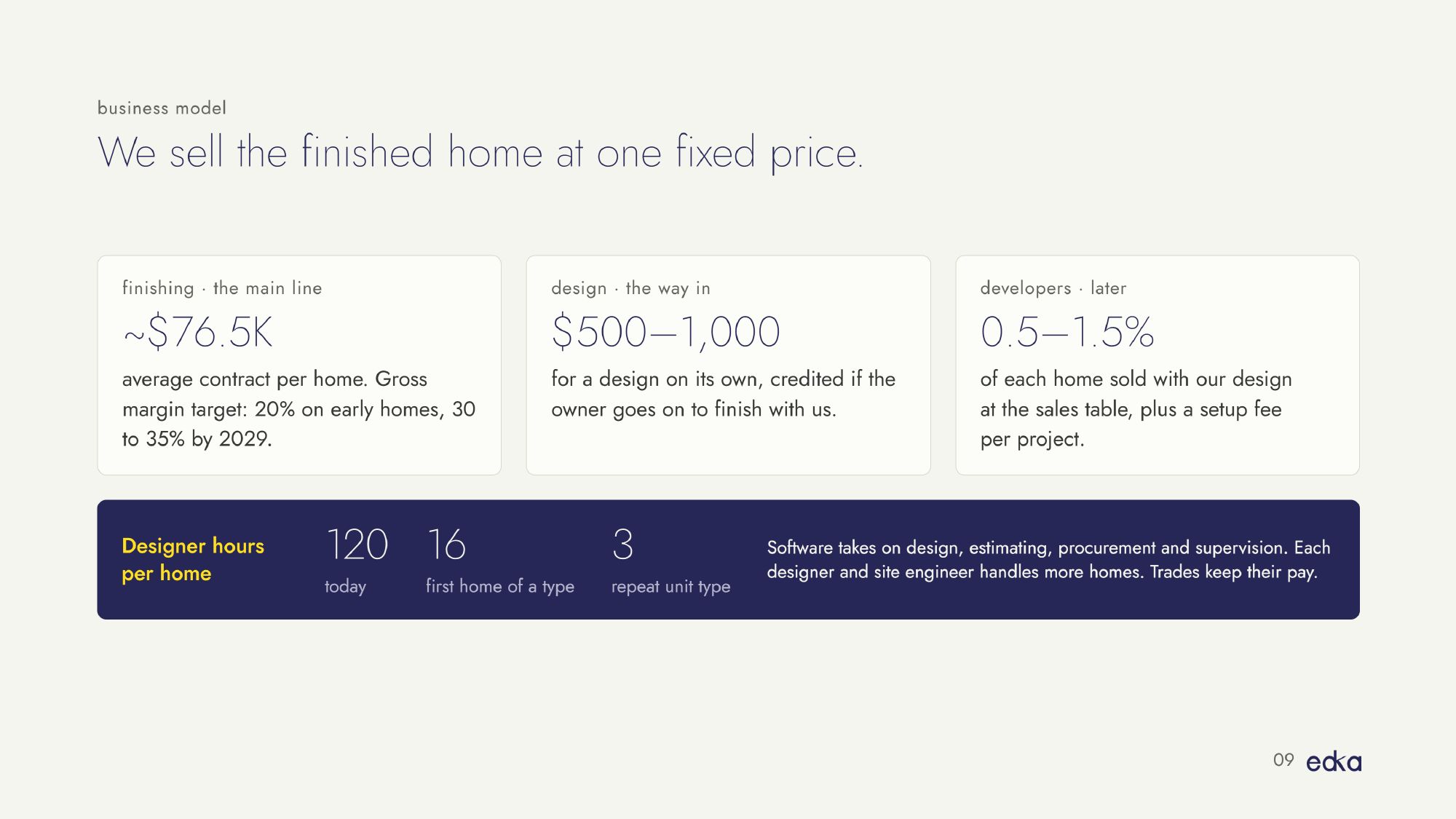
- Finished homes, the main line. The owner pays Edka one fixed price to design and finish the home. Edka holds the contract, so its revenue is the contract value. We plan on an average contract of about $76,500 per home (target). The owner pays on a payment plan of instalments.
- Design, the way in. An owner can buy a design on its own for $500 to $1,000 (target). The fee is credited if the owner goes on to finish the home with Edka.
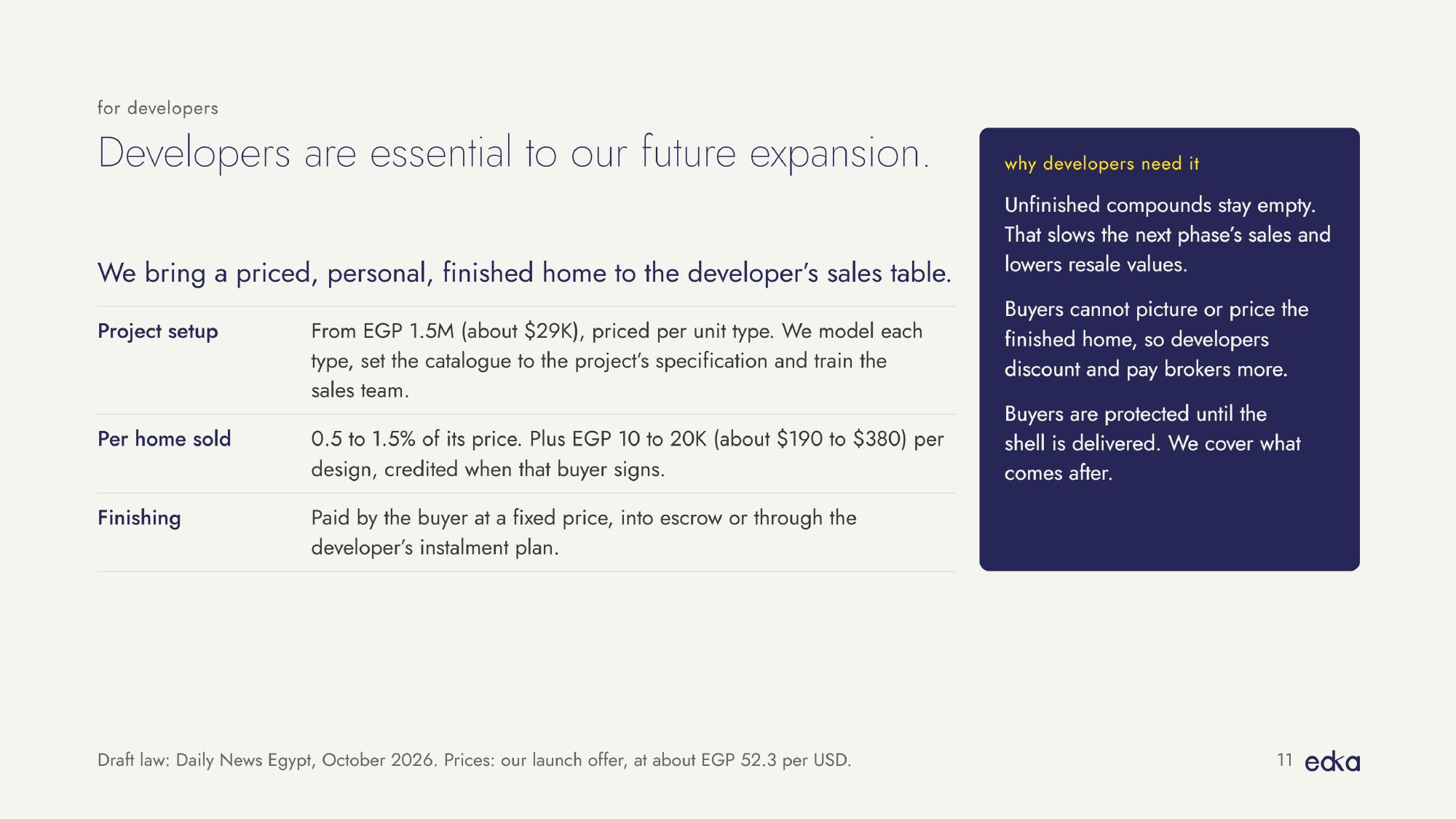
- Developers, later. A setup fee per project, and 0.5 to 1.5% of the price of each home sold with our design at the developer's sales table (target).
Pricing and margin
The price is set just below what premium design studios charge, not like a contractor's price. Our gross margin target is 20% on the early homes, rising to 30 to 35% by 2029 (target).
Why margins can grow
Software takes on design, estimating, buying and supervision, so each designer and site engineer handles more homes. Designer time falls from about 120 hours per home today (estimate) to 16 hours for the first home of a unit type and 3 hours for a repeat unit type (targets). Trades keep their pay: Edka pays them for each finished, checked piece of work.
The plan (targets)
| Year | Homes | Share of the 29,000 homes a year | Contract value |
|---|---|---|---|
| 2027 | 10 signed | 0.03% | $0.8 million |
| 2028 | 100 delivered | 0.3% | $7.7 million |
| 2029 | 400 delivered | 1.4% | $30.6 million |
| 2031 | 1,300 delivered | 4.5% | $99.5 million |
The plan assumes about $76,500 per home, at about EGP 52.3 per US dollar. Each stage must work before the next one starts: the first homes must come in within 10% of the cost we estimated before signing before we scale.
Team
Three co-founders, friends for 17 years.
Mohamed Sakr, co-founder and CEO: design and delivery
- Founded Studio Mesaha, an architecture and design studio, with its own clients, crews and suppliers.
- Seven years designing and building homes in Egypt.
- Architect, University of Manchester.
- At Edka: leads design direction, delivery on site, the rules a good design must follow, and the product catalogue.
Yusuf Ashmawi, co-founder and CPO: product and data
- Built Roomery, an AI furniture tool that became Edka.
- Six years in urban data and policy; built MetroFutures for Metropolis.
- McGill University and Sciences Po Paris.
- At Edka: leads the product and how the team works, and built the first version of Edka's data model and product catalogue.
Ali Embabi, co-founder and CTO: engineering
- Senior Software Engineer at Meta since 2022: tech lead on Meta's new AI game creation product. Led a pod of four engineers through the alpha launch of its feed, then led publishing as tech lead and acting product manager.
- Software Engineer at Amazon Web Services, 2018 to 2021: built financial data platforms for AWS FinTech, including data pipelines that automate bad-debt reserve calculations and anomaly-detection tools for accountants.
- Computer science, University of Michigan.
- At Edka: leads engineering and the technical design of the product.
Hiring next
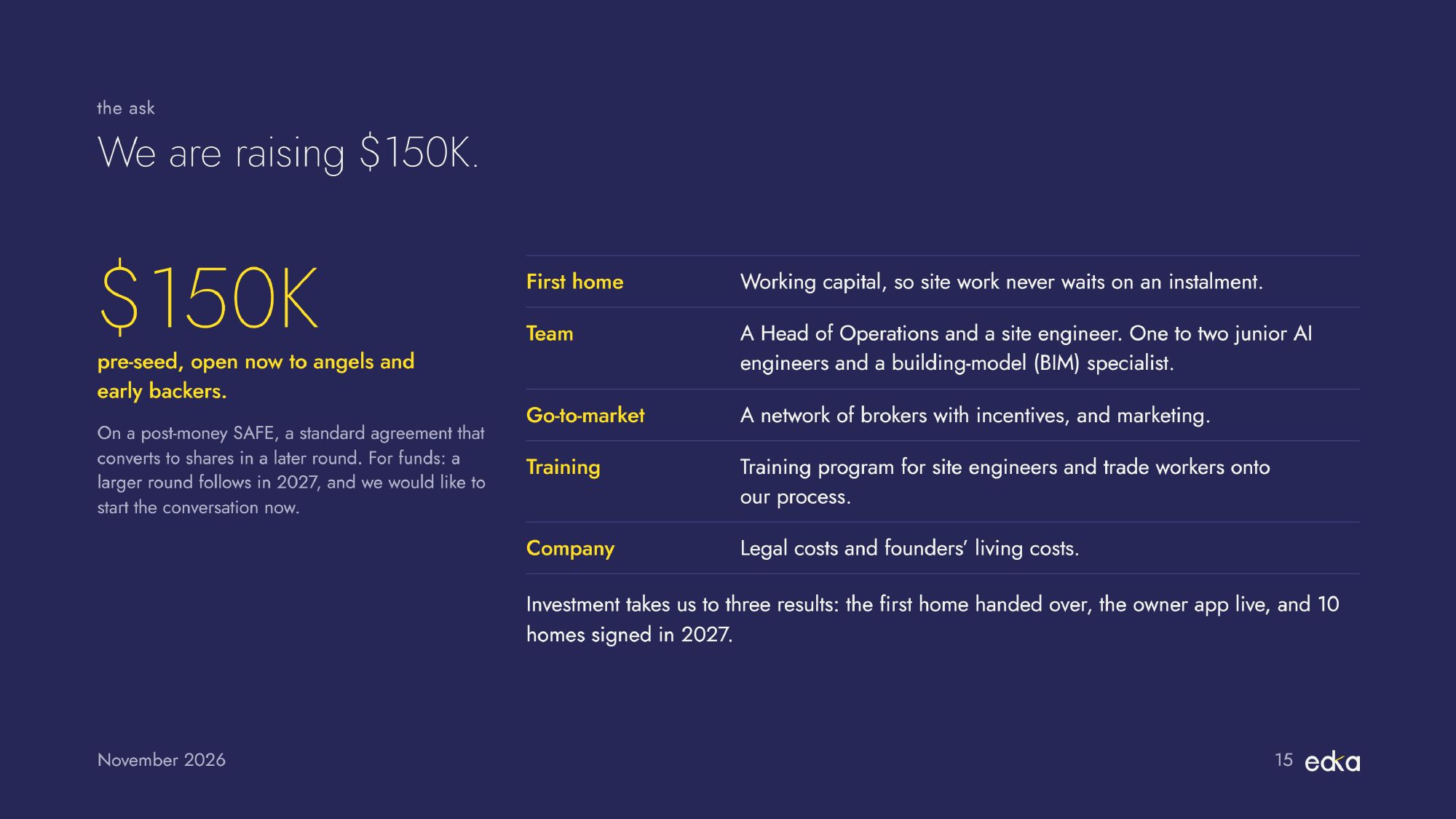
A Head of Operations and a site engineer.
Contact
Mohamed Sakr: mohamed.sakr@edka.com
Yusuf Ashmawi: yusuf.ashmawi@edka.com
Ali Embabi: ali.embabi@edka.com
Company and legal
Company facts, and what we share on request.
Company
- Legal name: Edka Labs, Inc.
- Incorporated in: Delaware, United States, as a C corporation.
- Egyptian company: Edka Labs LLC.
- Headquarters and first market: Egypt.
Documents available on request
Corporate and legal documents, the ownership table and the terms of any investment are not kept in this data room. We share them directly with 500 Global on request, at the stage of the process where they are needed.
Technology and architecture
What the system is made of, not how each part works.
The principle
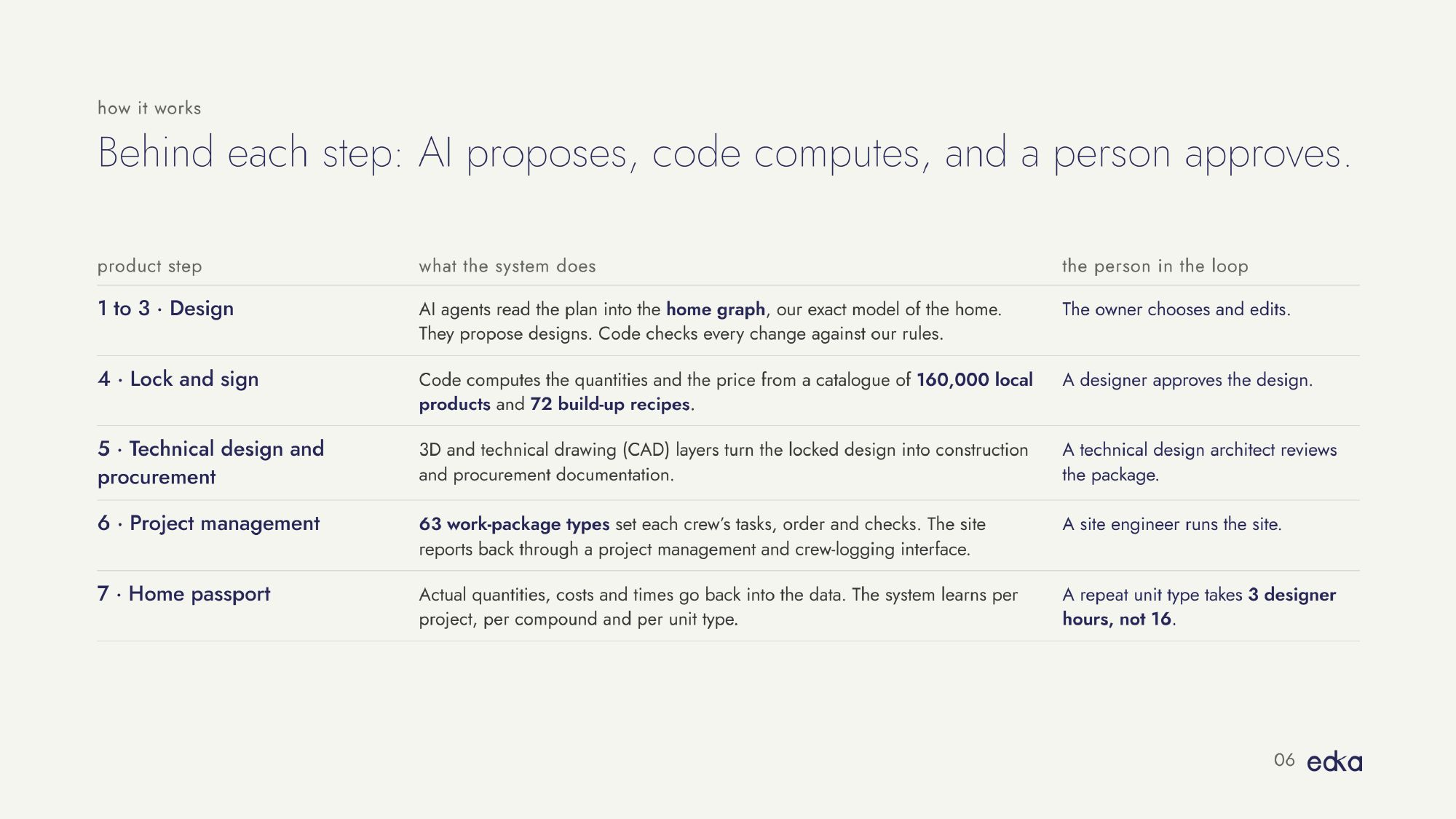
AI proposes, code computes, and a person approves: an Edka designer approves every design before the owner sees it. AI models suggest designs and read plans and briefs. Our own code works out every number promised to an owner: the price, the quantities and the dates. The same design always gives the same price, and any price shown to an owner can be worked out again exactly.
The main parts
- The owner app. A web app for phones and laptops. The owner gives the brief, sees the home in 3D, changes the design and sees the price change.
- The home record. One exact digital model of each home: its rooms, walls, openings, services and every product placed in it. Every change is checked before it is saved, and every version is kept.
- The engine. Our code that works out the quantities, the price, the bill of quantities (the priced list of everything needed), the work packages and the schedule from the home record. It never calls an AI model.
- The design agents. AI agents that read a home's plan, read the owner's brief and propose designs. They can change a home only through the same checked commands as everyone else.
- The catalogue and the libraries. Egyptian products with dated prices, sizes and 3D models, and our own libraries of design rules, build-up recipes (the layers behind each finish) and work packages.
- 3D and pictures. One 3D model per design version. The live 3D view and the finished pictures use the same files, so the pictures match what is built.
- The AI gateway. Every call to an AI model goes through one gateway of our own. It records each call and its cost, caps the spend per home, and keeps owners' personal details away from AI providers.
- The delivery tools. Orders, crew schedules and progress checks for the site, made from the locked design.
- The data loop. The real quantities, costs and times from each finished home go back into our data and improve the next estimate.
The tech stack
| Area | What we use |
|---|---|
| Languages | TypeScript for the whole product. Python only for separate workers, such as rendering and catalogue import. |
| Apps | React, with three.js for 3D (through React Three Fiber) and React Router. The public website is built with Astro. |
| Backend | One TypeScript server built on Hono, with a separate worker for long jobs. |
| Data | Postgres, with pgvector for search by likeness in the catalogue. Files such as 3D models and pictures on Cloudflare R2. |
| Hosting | Render and a managed Postgres (Neon), both in Frankfurt. Cloudflare for files and the public website. Modal for jobs that need a graphics chip. |
| AI models | OpenAI, Anthropic and Google, each used for the steps where it does best, called through the Vercel AI SDK and our own gateway. |
| 3D and pictures | Our own 3D builder in TypeScript. Blender for finished pictures. AI image models for styling, checked by our own code. AI-made 3D models of furniture, checked by our own code. |
| Quality | Automated tests on every change (Vitest and Playwright). Scored tests for every AI step, viewed in Langfuse. Error tracking with Sentry. |
Choices that keep us free to change
- We build the parts our promise to owners rests on: the home record, the engine and the checks. We buy what changes fast and what many firms need in the same way, such as AI models.
- Every bought tool takes and returns open file formats, so it can be replaced.
- Any host or AI provider can be replaced without rebuilding the product. Each part uses ordinary, widely used technology.
Shared on request
Corporate and legal documents and the ownership table are not in this data room. We share them directly when they are needed.